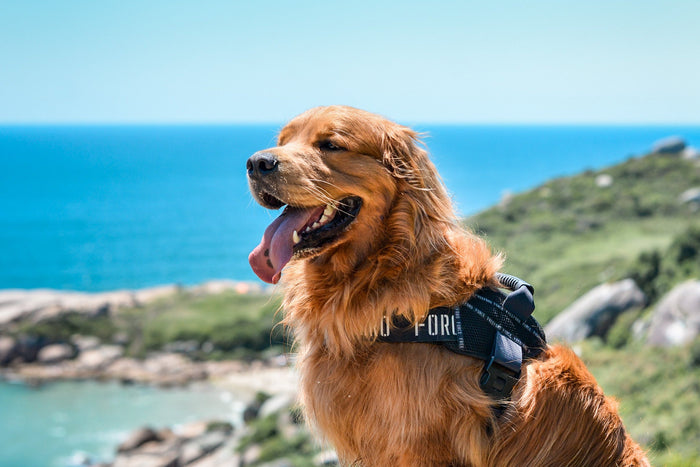
Harness or Collar: Which Is Better for Your Dog?

Short answer: for walks, a harness is the safer choice for most dogs, because it spreads the pull across the chest instead of the neck. A collar is still useful every day to carry an ID tag and for calm dogs on short walks. Most owners end up using both: a collar at home, a harness on the leash.
“Harness or collar?” is one of the first questions new dog owners ask. The honest answer depends on how your dog walks, its size and its build. This guide compares the two side by side and tells you which one to use in each situation.

Harness vs collar at a glance
| Harness | Collar | |
|---|---|---|
| Where the pull goes | Chest and shoulders | Neck |
| Best for | Dogs that pull, puppies, small and flat-faced breeds, long walks, car journeys | Calm dogs on short walks, carrying an ID tag |
| Control | More, especially with a chest ring | Less when the dog pulls |
| Escape risk | Low when fitted correctly | Higher if the dog backs out |
| Put on and off | A few seconds more | Very quick |
| Wear all day | Take it off at home | Yes, with an ID tag |
When a harness is the better choice
- Your dog pulls. With a collar, every pull lands on the neck. A harness moves that force to the chest. A no-pull harness with a chest ring also turns the dog gently back towards you when it pulls.
- Small breeds and flat-faced breeds such as pugs and French bulldogs are often advised to walk on a harness, to keep pressure off the neck and airway.
- Puppies that are still learning to walk on a leash.
- Long walks, hikes and running, where comfort over hours matters. For running, pair it with a hands-free leash.
- Car journeys. A dog seat belt must always be clipped to a harness, never to a collar.

When a collar is enough
- Calm dogs that already walk on a loose leash, for short walks around the block.
- Every day, at home and outside, to carry an ID tag with your phone number. A tag is the fastest way for a neighbour to bring a lost dog home.
- Quick moments, such as going down to the garden.
If your dog has breathing, neck or back problems, ask your vet before choosing; in most of these cases a harness is the better option.
Which harness type?
- Air: ergonomic neoprene, two adjustment points. Everyday comfort.
- H: classic shape, every strap adjustable. Good for deep-chested or slim dogs.
- No-pull: leash rings on the chest and the back. For dogs that pull.
- Force: tactical harness with a top handle, for medium and large dogs.
Not sure about the size? Read our guide how to measure your dog for a harness.
And for cats?
Cats should only wear a collar with a breakaway buckle, which opens if the collar gets caught. For walks on the balcony, in the garden or to the vet, use a cat harness with leash: never attach a leash to a cat’s collar.
The answer most owners choose: both, in the same print
A collar with the ID tag stays on; the harness goes on for the walk; the leash matches both. Every FreeFaro print comes as a harness, a leash and a collar, so the set matches. Browse by print, from Ipanema to Darkest, and build yours.

Frequently asked questions
Is a harness better than a collar?
For walks, yes for most dogs, because it spreads the pull across the chest. A collar is still the best place for an ID tag.
Can a dog wear a harness all day?
It is better to take it off at home, so the coat and skin can breathe and the straps do not rub. Keep the collar on for identification.
Does a harness make a dog pull more?
A back-clip harness does not stop pulling on its own. If your dog pulls, use a no-pull harness with the leash on the chest ring, together with training.
Should I use a harness or a collar for a puppy?
A harness for walks while the puppy learns, plus a light collar for the ID tag. Measure again every few weeks as it grows.
Harness or collar for a small dog?
A harness for walks. Small dogs have delicate necks, so it is better to keep the pull away from them.
Written by the FreeFaro Europe team, official importer of FreeFaro in Europe. This guide is general advice; for dogs with health problems, follow your vet’s recommendation.